
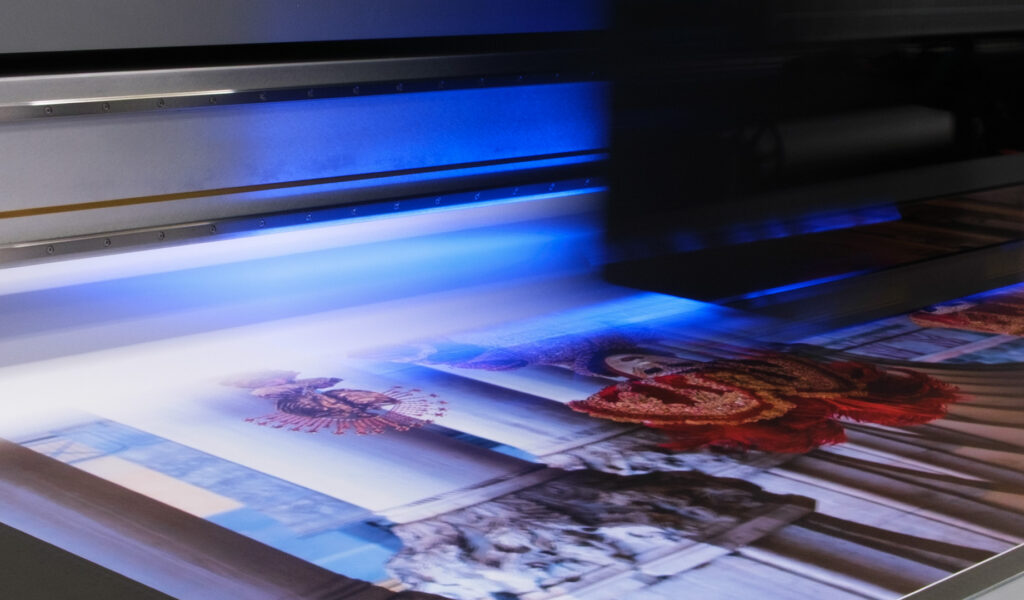
UV printing is a significant technology in modern industrial printing. From graphic display, to labels and packaging, product decoration and industrial manufacturing, UV-curable inks enable high production speeds, high durability and substrate flexibility.
For businesses developing or operating industrial printing systems, UV printing offers a combination of productivity, performance and versatility. Print system manufacturers, label converters, packaging producers and industrial manufacturers rely on UV inkjet technology to support advanced production environments where efficiency, reliability and material compatibility are critical.
Contents
What Is UV Printing?
In traditional printing systems, inks typically dry through evaporation of solvents or absorption into porous substrates such as paper. This process requires time and often involves drying tunnels, heat or airflow to remove moisture or solvents.
UV printing works differently. UV-curable inks contain chemical components that react when exposed to ultraviolet energy. When the ink is exposed to a UV light source, a photochemical reaction occurs that causes the liquid ink to rapidly polymerise into a solid film. This process is known as UV curing.
Because the ink cures instantly rather than drying gradually, printed material can move directly to downstream processes such as cutting, laminating, finishing or packaging.
For industrial printing environments, this ability to print and cure instantly provides significant operational advantages, particularly in high-speed production lines or automated manufacturing workflows.
How the UV Printing Process Works
Although UV printing is often associated with digital inkjet printing, the technology is used across many printing methods, including flexographic, offset, screen and pad printing. Regardless of the printing method, the fundamental process follows the same sequence.
Ink deposition
The first stage of the process involves depositing the UV ink onto the substrate. In digital print systems, this is done using inkjet printheads, typically piezoelectric drop-on-demand technology, which precisely places droplets of ink onto the surface.
UV exposure
Immediately after deposition, the printed ink passes under a UV light source. UV curing systems generate ultraviolet energy that activates the chemical components within the ink formulation.
Two main types of curing systems are used in modern printing equipment:
- Mercury arc UV lamps
- UV LED curing systems
Both technologies deliver the energy required to initiate the curing reaction, although they differ in wavelength output, thermal characteristics and energy efficiency.
Photochemical curing
When the UV light reaches the ink, specialised molecules known as photoinitiators absorb the energy and generate reactive species. These reactive molecules trigger a polymerisation reaction between monomers and oligomers in the ink.
The result is rapid crosslinking of the ink components, transforming the liquid ink into a solid polymer network.
This chemical transformation occurs extremely quick, often within fractions of a second, allowing the printed image to cure almost immediately.
Immediate post-processing
Once cured, the printed surface becomes dry and durable. Because the curing process happens instantly, printed materials can move directly to downstream production processes like cutting, folding, creasing, lamination, winding or further print passes.
For production environments, this immediate handling capability can significantly increase throughput and reduce bottlenecks in manufacturing workflows.
Key Components of UV Printing Technology
The performance of UV printing systems depends on the interaction between several core technologies, including ink chemistry, curing systems and printing hardware.
UV ink formulations
UV inks are fundamentally different from solvent or water-based inks. Instead of relying on evaporation, they are formulated to undergo a chemical reaction when exposed to ultraviolet light.
Typical UV ink formulations contain several key components:
- oligomers, which determine the mechanical properties of the cured ink film
- monomers, which control viscosity and influence curing behaviour
- photoinitiators, which absorb UV energy and initiate the curing reaction
- pigments and additives, which provide colour and modify ink performance
The combination of these components determines characteristics such as adhesion, flexibility, chemical resistance and durability.
Ink formulation is therefore a critical aspect of UV printing technology, particularly for specialised industrial applications where performance requirements may vary widely.
UV curing systems
The curing unit provides the energy required to trigger the polymerisation process.
Traditional UV curing systems use mercury arc lamps that emit a broad spectrum of ultraviolet wavelengths. These systems have been widely used in printing for decades and are capable of curing a wide range of ink chemistries.
More recently, UV LED curing technology has gained significant adoption across the printing industry. LED systems emit light within narrower wavelength bands and typically generate less heat than conventional arc lamps.
For many modern printing applications, LED curing systems offer advantages including energy efficiency, longer operational life and improved compatibility with heat-sensitive substrates.
Printheads and ink delivery systems
In digital UV printing systems, printheads play a central role in determining print quality and productivity.
Industrial UV inkjet printers commonly use piezoelectric printheads capable of ejecting extremely precise droplets of ink. These printheads must be compatible with the viscosity and chemical characteristics of UV inks while maintaining high reliability under continuous production conditions.
Advanced ink delivery systems also ensure consistent flow, pressure control and temperature management to support stable printing performance.
Substrate preparation and surface interaction
Successful UV printing depends not only on the ink and curing system but also on the interaction between the ink and the substrate.
Surface energy, cleanliness and material composition can all influence ink adhesion and final print quality.
In some applications, primers or surface treatments may be used to improve adhesion or ensure consistent ink performance across different materials.
Who Uses UV Inkjet Printing?
UV printing is widely used across industrial printing markets where durability, speed and substrate flexibility are important production requirements.
Label converters
The label printing industry has adopted UV printing extensively, particularly in digital inkjet systems.
UV-curable inks provide the durability required for labels used in consumer products, logistics and industrial applications. Because labels are often printed on filmic materials such as polypropylene or polyethylene, UV inks are well suited to these substrates.
Fast curing also enables high-speed single-pass printing, which is essential for efficient label production.
Packaging manufacturers
Packaging producers increasingly use UV printing technologies for both flexible and rigid packaging applications.
UV inks can provide strong adhesion to plastic packaging films and other non-porous materials, making them suitable for a wide range of packaging formats including beverage cans, plastic containers, and flexible packaging.
As packaging production continues to adopt digital and on-demand printing models, UV inkjet technologies, with indirect food-contact safe formulations, play a growing role in these environments.
Sign and display printing
Large-format printing systems used in signage and display graphics often rely on UV ink technologies.
UV inks provide durability and resistance to environmental exposure, making them suitable for applications such as retail displays, exhibition graphics and outdoor signage.
Because UV printing can be used on rigid substrates, including acrylic, PVC and metal panels, it allows sign producers to use a range of printable materials.
Industrial manufacturing
In many industries, printing is integrated directly into manufacturing processes rather than being a standalone graphic service.
UV printing is used in industrial applications such as:
- product decoration
- electronics marking
- automotive component printing
- security printing and coding
In these environments, the ability to cure ink instantly is particularly valuable because it supports automated production lines and high-speed manufacturing processes.
Materials Compatible with UV Printing
One of the key advantages of UV printing is its compatibility with a wide range of substrates.
Because UV inks cure through polymerisation rather than absorption, they can adhere to materials that are difficult to print with other ink technologies.
Common substrates used in UV printing include:
- plastics such as acrylic, polycarbonate and PVC
- metal surfaces
- glass
- coated papers and boards
- flexible packaging films
- wood and decorative materials
This material flexibility has helped UV printing become widely adopted in industrial and commercial printing markets where diverse substrates are common.
Applications of UV Printing
UV printing is used in a wide range of applications across multiple industries.
Labels and packaging
Label and packaging production represents one of the largest markets for UV printing. UV inks provide the durability required for product labels while enabling high-speed production workflows. Discover more about UV printing for labels and packaging.
Retail graphics and displays
Retail environments frequently rely on large-format UV printing for promotional displays, signage and point-of-sale materials.
The ability to print directly onto rigid materials allows retailers and brand owners to create customised display solutions.
Product decoration
Many manufacturers use UV printing to apply graphics or branding directly to products. This can include printing onto plastic components, electronic devices or decorative surfaces.
Direct-to-object printing
UV printing systems are increasingly used to print directly onto three-dimensional objects such as bottles, containers and industrial parts.
This capability allows manufacturers to integrate printing directly into production processes.
Industrial coding and marking
UV inkjet systems are also used for coding, marking and traceability applications, particularly where durable identification marks are required.
Advantages of UV Printing for Businesses
For organisations involved in printing and manufacturing, UV printing offers several important operational advantages.
Faster production speeds
Because UV inks cure instantly, printed materials can move directly to the next stage of production. This reduces waiting time between processes and supports high-speed manufacturing environments.
Durability and resistance
UV-cured inks form strong polymer networks that provide resistance to abrasion, chemicals and environmental exposure. This durability makes UV printing suitable for demanding industrial applications.
Expanded substrate compatibility
The ability to print onto non-porous materials allows businesses to expand their range of printable products and applications.
Reduced drying infrastructure
Traditional printing processes often require large drying systems or extended dwell time. UV printing reduces or eliminates these requirements, allowing more compact production setups.
Support for digital production
UV printing technologies are widely used in digital inkjet systems, enabling short-run production, variable data printing and on-demand manufacturing.
Regulatory considerations in UV printing
In certain applications, particularly packaging, regulatory requirements may influence ink formulation and curing processes. Migration characteristics and chemical safety must be carefully managed to ensure compliance with regulation.
The Future of UV Printing
UV printing continues to evolve as new technologies and materials are introduced across the printing industry.
Advances in UV LED curing, improved ink formulations and high-speed industrial inkjet systems are expanding the range of applications where UV printing can be used.
As manufacturing processes become increasingly automated and demand for short-run production grows, UV printing technologies will continue to play an important role in industrial printing environments.